Why do you want to be a Local Hero?
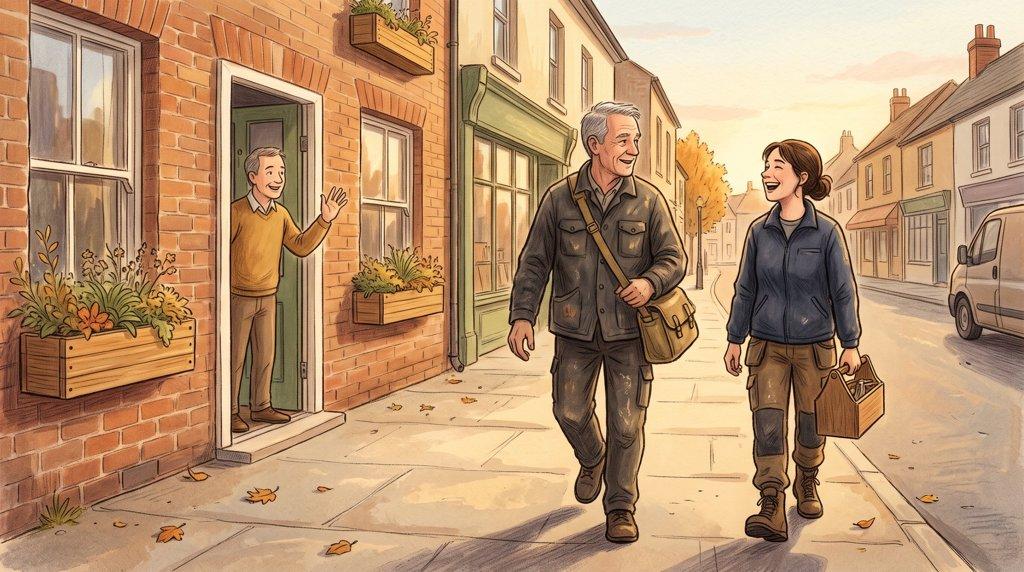
We are coming to the end of this short article series, and I very much hope that you now have a good plan for becoming a Local Hero.
I often interview well-established entrepreneurs on stage, Sir Richard Branson probably being the best known. I always ask them why they decided to start a business in the first place. Their replies vary, but a common answer, especially once they have had some success, is ‘to make the world a better place’.
As a Local Hero, you are doing exactly that. Of course, the increase in revenue can pay for many things that you want or need. But, above all, you can be proud that, in delivering your services, you are making people happy. Whatever your customers’ own life goals, you are helping them achieve them.
The basis of our Beermat sales model is understanding customers’ needs. But what about your own personal needs as a Local Hero? Here is the basic science behind what people need out of life.
Abraham Maslow, in his 1943 paper ‘A Theory of Human Motivation’, suggests that human actions are guided by a sequence of needs organised in a pyramid. Foundational lower-level needs must be addressed before higher-level growth needs become dominant.
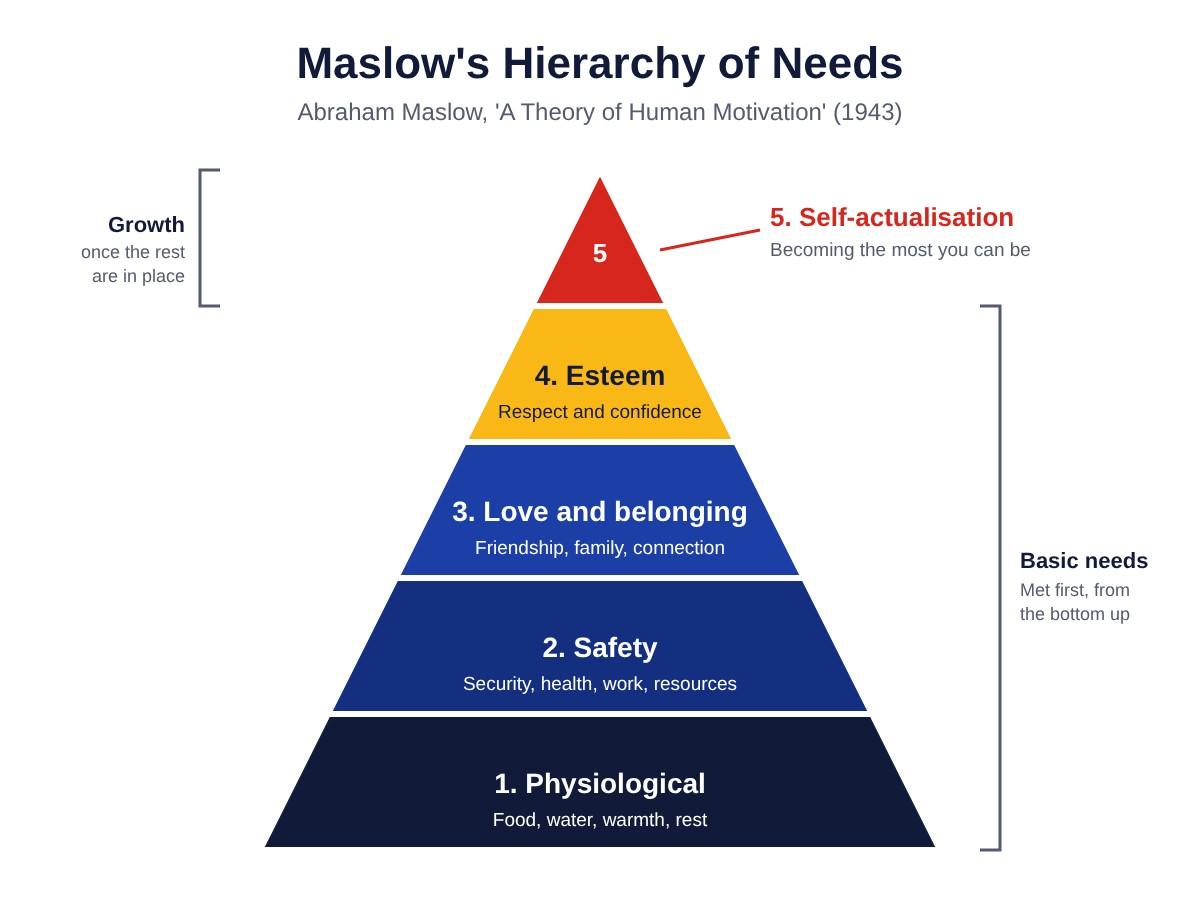
As a Local Hero, you are already at Level 3, and are beginning to move into Level 4. As you progress up, you will soon be formulating your ideas on that fascinating subject, The Meaning of Life: essentially a combination of how you understand your place in the world and the personal value you provide.
You have plenty of source material for learning about yourself, from expert philosophers. There are historical ones (for example Plato, Kant, Descartes and Hume), contemporary ones (Peter Singer, Martha Nussbaum, Noam Chomsky and Judith Butler), physicists (Isaac Newton, Marie Curie, Albert Einstein and Stephen Hawking) and entertainers (Monty Python, Douglas Adams, Peter Gabriel, and many stand-up comedians, who use comedy for effect).
This gives us good material for conversations in the pub or coffee shop with people whose opinions you value. This is not just friends, but also your favourite customers, so long as you do not fall into a heated discussion which might jeopardise your contract!
We live in desperate times, with (seemingly) only bad news on the TV. Many of the problems of the world are caused by politicians and business people who do not seem to have you and your family’s best interests at heart.
But you are an entrepreneur working on a daily basis to please people, in your own modest way. You are also in stealth mode, looking to (legally) sidestep obstacles, such as unpleasant politics and unnecessary bureaucracy, wherever you can.
You may have made the big step from a corporate life, where the pay was good, but you were not 100% aligned with their business methods or activities. Your home life, the most important aspect of your life, is now calmer and more fulfilling. You have more time for the people who really matter.
You are on your journey toward the top element in Maslow’s Hierarchy of Needs: Self-Actualisation. You are learning who you are, and your place on Earth, however modest.
I will do everything I can to assist you in this journey. Much of this is in the form of tips and tricks to help you with your business career, such as how to sell (my specialist subject). But I hope you are getting the feeling that my motives are good. I am not just looking to ‘get rich quick’. That already happened in 1991, and I have been (relatively) serene ever since.
But I am happy to share my learned insights into The Meaning of Life, as I understand it. Your version might, of course, be completely different. But I hope this gives you some food for thought.
My journey into thinking about something more profound than just securing the next sale began in 2002, with the publication of our book The Beermat Entrepreneur. Fortunately for me, my co-author Chris West already had a First-Class Honours Degree in Philosophy from the London School of Economics.
So rather than the book being a series of amusing anecdotes from my life and some sales tips, it had a logical structure as well as (though I didn’t realise it at the time) sound philosophical roots.
The Beermat on the front cover featured the word ‘Mentor’, so with the book’s immediate success, I began being approached by people who asked me if I would mentor them. Learning how to do this effectively was a major effort. Simple sales tips are very straightforward, but dealing with essentially troubled, difficult or just unfocused people was a real challenge.
More specifically, I suddenly found myself giving out moral pronouncements on the difference between what I considered to be ‘good’ and ‘evil’. Having absolutely no real understanding, qualifications or authority in this area, I realised I had better start learning.
I have spent the last 25 years studying in this area. This has been a fascinating journey, which continues on a daily basis. My surprising conclusion, after a few years’ work, was that all philosophical, ethical and even religious systems seem to have the same three common elements. Here is my interpretation of them.
1. Treat People Like You Would Like to Be Treated Yourself
Often called ‘The Golden Rule’, the lack of it can often be seen when an arrogant person publicly berates someone they consider inferior for a mistake, such as poor customer service. This Bully really needs to get over themselves.
2. Help People, but Don’t Go Broke in the Process
Charity is a wonderful thing, and most laudable, but should only be done after you have secured your revenue for that month. More precisely, ‘not to the detriment of yourself or your connections’. Earn a living first, then help people!
3. Tell The Truth
This may seem obvious, but it is my Number One Tip for salespeople. Those who tell lies just to secure a sale will never get any repeat business, so will ultimately fail. Sometimes it is hard to be diplomatic, especially in a personal context, but, if in doubt, say nothing (another top sales tip).
If you follow these rules, your ‘Wealth’ as well as your ‘Revenue’ will increase. ‘Wealth’ represents your non-tangible value: your reputation and standing amongst others.
So, I wish you a very happy life as a Local Hero. You may pass on your Legacy to another Local Hero. This could be a younger person who you take on to keep you company on your assignments and to learn your trade.
One day, they will themselves become a Local Hero in their own right, having learned about sales, delivery and finance from your excellent example. You should be really proud when this happens.
Of course, a great Legacy is in your own children, if you are lucky enough to have them. If not, there are plenty of other options, such as being a guest lecturer or mentor at a school or college.
Finally, when the time comes, you hope that everyone at your funeral will say that you ‘lived respected and died regretted’. This could be illustrated by the music you choose.
Mine will be a piece of music that I often play at live events. My specialist subject is The Beatles, and it will be The End, from the album Abbey Road, with its famous closing line about the love you take and the love you make.
Get each new part by email as it comes out.
One email when each new part goes up, plus the odd note from Mike. Nothing else.